





30 Days


Quick Facts

Ground transportation in Nepal

Hotels & tea-house accommodation

All meals except in Kathmandu

Guided tour & trek throughout the trip

Autumn, Spring

Difficult

Nepal

6,812 m

Kathmandu - Lukla - Namche - Tengboche - EBC Ama Dablam - Lukla - Kathmandu


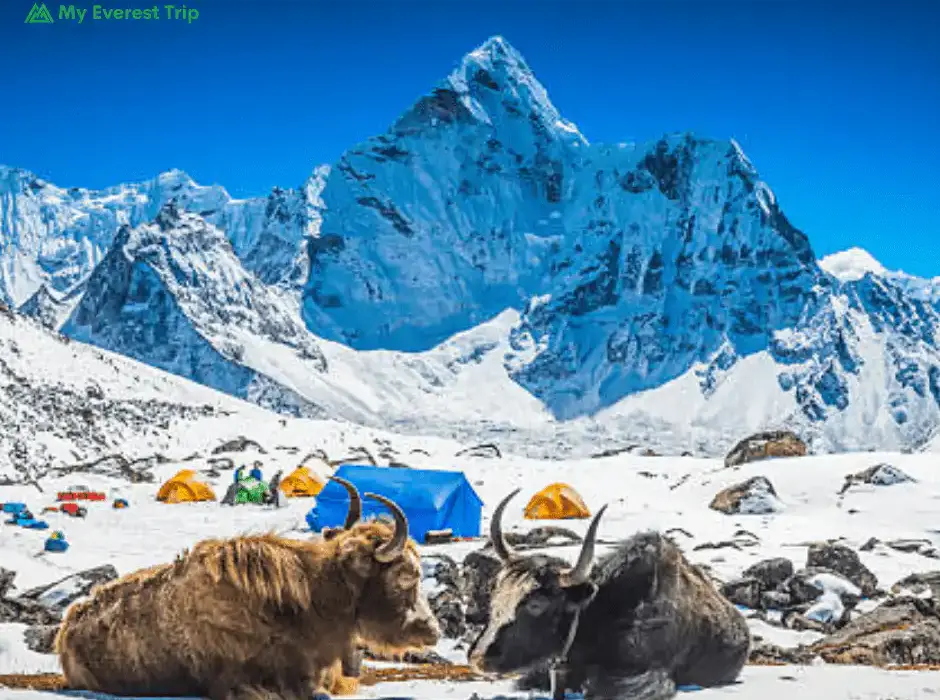
Why Ama Dablam Expedition?
- Climb to the base camp of Ama Dablam on a short and easy trek.
- An easy, affordable, and culturally rich trekking experience for both beginners and expert hikers.
- Parallel views of the world’s tallest mountain from 4200m above sea level.
- Explore the rich cultural heritage of the Sherpa people.
- Wander in the world’s best trekking place, i.e., the Sagarmatha region.
- An authentic mountain climbing experience, along with the thrill of hiking.
- Witness the rare flora and fauna in Sagarmatha National Park.
Trip Overview
The Mount Ama Dablam Expedition involves challenging climbing on Ama Dablam. Nepal’s high mountain peaks make it one of the most remote places in the world. Trekking to the Khumbu region is a true thrill. The Ama Dablam Expedition will have memories of the best mountains that will bestow on you a lifetime of memories.
Conquer Himalayas Adventure Ama Dablam is the ‘Matterhorn of the Himalayas’ and stands tall and proud at 6812m. The fantastic mountain, considered one of Nepal’s most beautiful peaks, stands in the middle of the Khumbu Valley. The peak is unique in its sharply pointed shape and ascending profile. Summiting this peak is a dream come true for many climbers. They strive to conquer it and stand atop it, offering views of Mt. Everest (8848m), Lhotse (8516m), Cho Oyu (8201m), Makalu (8481m), and other peaks.
The expedition to Ama Dablam Peak (6,812 m) is demanding, offering numerous challenges and breathtaking views. The Ama Dablam Expedition requires good climbing skills to join and successfully climb Ama Dablam.
With the southwest face representing the sacred ornament box of Sherpa women called Dablam, this is the most visually striking peak in the world. Spending a night in such a prolific mountain’s base camp is our best day.
Ama Dablam Expedition Guide
The 30-day Ama Dablam base camp trek is a rewarding climb. You will explore the exotic Kathmandu city before flying into the remote mountain town of Lukla. Every expedition to Everest Base Camp begins from Lukla. First, we walk to the village of Phakding and then to the famous village of Namche. We stop at this spectacular village for a day. Then, we went to Pangboche before getting to the base camp of Ama Dablam.
You can climb to Camp II from the Base Camp and reach the Ama Dablam summit the next day. Here, the best views of Mount Lhotse, Mount Makalu, Mount Cho Oyu, and Mount Everest smile at us.
The mountain people’s unique Buddhist culture and lifestyle will delight you. These people practice their century-old traditions in their purest form and live peacefully within the mountains. This trek is the perfect blend of adventure, culture, and nature. At the same time, the well-developed trekking region of Ama Dablam also offers luxury and comfort. If you want a relaxing holiday with some thrills, this Ama Dablam hike is just for you.
MyEverestTrip has successfully run Ama Dablam expeditions in various parts of the Himalayas with a highly qualified team of experts and high-altitude climbers. We provide international equipment and guide you throughout the trip to minimize mishaps. Once you connect with us, we care for you throughout the journey.
Ama Dablam Expedition Itinerary
Day 01: Arrive at Kathmandu airport
Our representatives will warmly greet you at the airport. You will then be transferred to your hotel. Feel free to enjoy the rest of the day!

Dinner

Hotel

1,400 m / 4,593 ft
Day 02: Pre-trip meeting and sightseeing around Kathmandu valley
On this day, you will visit various UNESCO World Heritage sites to explore more about Kathmandu’s culture and architecture. You will also be given detailed information about the plans, precautions, and trials.
Breakfast
Hotel
1,400 m / 4,593 ft
Day 03: Official formalities in Kathmandu
Today is when you will be taken to our main office so that we can complete the necessary formalities before we head out on the trek. Feel free to stroll around the city during your spare time.
Breakfast
Hotel
1,400 m / 4,593 ft
Day 04: Final preparation day in Kathmandu
Today will be the final day in Kathmandu. We will check your clothes and trekking instruments before we head toward the trip.
Breakfast
Hotel
1,400 m / 4,593 ft
Day 05: Fly to Lukla & trek to Phakding
We will fly to the most dangerous airport in the world, Lukla, which takes about 40 minutes, then descend slowly, bypassing the village of Chauri Kharka and passing through the small forest. We walk along a trail alongside the Dudh Koshi River to reach Phakding.
Breakfast, Lunch, Dinner
Teahouse

8 km / 5.0 miles
2,860 m / 9,383 ft

3hrs
Day 06: Trek to Namche Bazaar
We follow the trail through pine forests to Benkar (2700m), ascend to Chumoa, and descend to Monjo Khola. Then, we trail until we reach Namche Bazaar, called the Gateway to Everest.
Teahouse
3,440 m / 11,286 ft
Breakfast, Lunch, Dinner
Day 07: Namche Bazaar acclimatization day

We will stay here to get used to the environment and trek to a museum showcasing the Sherpa traditions. You will get a sight of the beautiful Everest (8848m) and Amadablam (6812m)—the peak you are about to climb. We hike up to Syangboche Airport and explore Khumjung village (3800m), the most significant Sherpa settlement in the Khumbu region.
Teahouse
3,800 m / 12,467 ft
Breakfast, Lunch, Dinner
Day 08: Trek to Tengboche Monastery
We trek uphill to Tengboche, passing Phunki Thenka, to reach Kyanjuma. Later, we trek down to Monjo and along the Dudh Koshi River to Tengboche.
Breakfast, Lunch, Dinner
Teahouse
9 km / 5.6 miles
3,867 m / 12,687 ft
5hrs
Day 09: Trek to Dingboche
We ascend to Dingboche to see the fantastic view of Everest (8848m), Lhotse (8526m), Nuptse (7861m), and Amadablam (6812m). We cross the Imja Khola and trek uphill to Pangboche Gumba, the oldest monastery in this region. We continue to walk to Shomare and then to Dingboche. As we walk, we can see the mighty Ama Dablam before us.
Breakfast, Lunch, Dinner
Teahouse
11 km / 6.8 miles
4,410 m / 14,469 ft
5hrs
Day 10: Acclimatization day
You will rest in this beautiful place in the Chukhung valley. You can experience the Imja River directly flowing east amid stone walls and the valley. You can find a fantastic view of the mountain range surrounding the valley. You can take help from the porters to learn more about altitude sickness.
Breakfast, Lunch, Dinner
Teahouse
4,410 m / 14,469 ft
Day 11: Trek to Ama Dablam base camp
The 30 Days Ama Dablam Expedition Cost is a comprehensive document outlining the expenses associated with the expedition organized by My Everest Trip. This formal guide provides a detailed breakdown of the costs involved in a 30-day expedition to Ama Dablam, one of the most iconic peaks in the world. From permit fees to transportation and accommodation, this document serves as a valuable resource for individuals planning to embark on this challenging adventure.
We cross the trails and walk towards the Dudh Koshi River. We ascend on a path that connects us to Ama Dablam Base Camp. The base camp is large and has open grassland at its foot. You will also be given information and safety measures.
Breakfast, Lunch, Dinner
Tent
6 km / 3.7 miles
4,600 m / 15,092 ft
4hrs
Day 12: Acclimatization day
Here we acclimatize and get training on peak climbing techniques, climbing gear, using ropes, and climbing skills, which can increase our chances of successful peak climbing. You will hike to get used to the altitude. You will also be given detailed information on safety measures.
Breakfast, Lunch, Dinner
Tent
4,600 m / 15,092 ft
Day 13-25: Climbing period of Ama Dablam (Ama Dablam climb via southwest ridge)
We move up to Camp 1 (5700m) along the standard trails, acclimatize, and then return to base camp. There are three camps above the base camp. The camps above Camp 1 are challenging, and we follow fixed trails. Camp 2 and Camp 3 are mostly icy and slippery. The climb from Camp 3 to the summit is less technical, and by day 25, we reach the summit and return to base camp.
Breakfast, Lunch, Dinner
Tent
6,812 m / 22,349 ft
Day 26: Trek back to Namche Bazaar
After the fantastic summit, we trek back to Namche Bazaar. We will see the same villages and mountain ranges, but the feeling this time will be different. You will descend downhill and rest throughout the day.
Breakfast, Lunch, Dinner
Teahouse
4,600 m / 15,092 ft
Day 27: Trek to Lukla
We walked for about 6 hours to reach Lukla. This will be our last evening of the expedition, a good opportunity for a small gathering with the porters and the local people. We will review our journey.
Breakfast, Lunch, Dinner
Teahouse
18 km / 11.2 miles
3,440 m / 11,286 ft
6hrs
Day 28: Morning flight back to Kathmandu
This morning, you will board a flight from Lukla to Kathmandu which will take about 40 minutes.
Breakfast, Lunch, Dinner
Hotel
2,860 m / 9,383 ft
Day 29: Leisure day in Kathmandu and cultural dinner,
After such a unique and strenuous trip, you will have a leisurely day to rest and relieve your body strains. Later, you will be taken to a cultural dinner at a restaurant.
Breakfast, Lunch, Dinner
Hotel
1,400 m / 4,593 ft
Day 30: Transfer to the airport for flight departure
After breakfast, you will be taken to the airport. You will be taken 3 hours before the scheduled time to board a flight to your home country.
Breakfast
1,400 m / 4,593 ft
Ama Dablam Expedition Map
What To Expect?
What's Included
- Three nights of Hotel accommodations in Kathmandu on a B/B basis;
- Pick up and drop off at Kathmandu airport. Surface transportation will be available as per the itinerary.
- Three meals a day (Breakfasts, Lunch, and Dinners with tea or coffee) during the trek and climbing period & night intent
- Trekking Permit (National Park entry fee)
- TIMS card (Trekking Information Management System) Permit
- Climbing permit and Domestic flights (KTM-Lukla-KTM) with all surcharges and airport taxes for guests and guide
- Necessary staff during the trekking and climbing period, with an experienced guide and a porter. experienced
- Government license holder, Climbing guide during the climbing period as per group size
- Group medical supplies (First Aid medical kit will be available)
- One tent will be open in the Base camp for two people on a shared basis.
- High-altitude food and all climbing crew will be available above the base camp.
- Necessary fixed and dynamic ropes will be available during the climbing period.
- The necessary kitchen crew will be available in the base camp
- Complete pre-departure information, flight ticket reconfirmation, and extend visa service(if required)
- Farewell Dinner in Kathmandu before departure.
What's Excluded
- Lunch and dinner in Kathmandu.
- Emergency rescue evacuation if required.
- Personal accident insurance or Helicopter rescue.
- Airfare for international flights
- Nepal entry visa fee, Visa issuance is accessible upon arrival
- Any Alcoholic, hot and cold drinks, hot shower.
- Personal climbing equipment
- Icefall fees, Garbage Deposit (Sharing with another member) if applicable.
- Travel Insurance

Tripadvisor Reviews


Google Reviews


Ama Dablam Expedition Additional Information
Ama Dablam Climbing Routes
The Ama Dablam expedition starts from Kathmandu, and we fly to Lukla. We gradually ascend uphill in Phakding. We enter the Sherpa capital, Namche Bazaar. We then reach the Khumbu Glacier, descend to Dingboche, and move towards Chukung Valley and Imja Tse base camp. After a night at the base camp of Ama Dablam, located at the southwest ridge, we attempt the summit. Ama Dablam consists of 3 campsites before reaching the peak. We proceed further up to Camp 1 (5,700 m) along the trails, acclimatize, and then return to base camp. Camp 2 and Camp 3 are mostly icy and slippery. We gradually adjust to the environment.
The climb from Camp 3 to the summit is less technical, and after two weeks, we summit the peak and then return to base camp. As we drove back to our accommodation, we could see the fantastic Chukung Valley, the villages, and the Himalayan range, including Mt. Everest (8848m), Mt. Makalu (8481m), Mt. Lhotse (8516m), and many other mountains. The journey ends when we fly back to Kathmandu from Lukla.
Cost to Climb Ama Dablam
The 30-day Climb to Ama Dablam costs about $6,500. With so many permits, gear, and workers, mountain climbing isn’t cheap. The cost includes the guide, porter, food, accommodation, flight, and permit. You may need an additional $500 for personal expenses and tips. Since this is not an actual mountain climb but a practice peak, the cost of the Ama Dablam climb is lower than for other peaks above 8,000 meters.
Ama Dablam Climb Difficulty
 Ama Dablam Difficulty
There are a few objective risks from the base camp to Ama Dablam Camp 1 (5800M). Climbers should cross on rough stones after arriving at Camp 1. Immediately after Camp 1, as you head towards Camp 2, there is a fixed line. Climbers should carry their backpacks, as porters aren’t available here. From here on, the climb becomes more complex and riskier. There are multiple hurdles before reaching the Yellow Tower.
Ama Dablam Camp 2 (6100 m) sits at the highest point of Yellow Tower, a straight 80-90-degree vertical climb. It is a 60-70 ft vertical movement at a 20,000 ft level, which isn’t easy. Camp 2 can house around 7 to 8 tents during the bustling season. It isn’t easy to find an optimal spot.
Climb to Ama Dablam Camp 3 (6400M) on the snow and ice that gathers during spring. The Ama Dablam route begins at the rear of the tower, and climbers must traverse ice or rock blocks. After heading up, there are specific rockfall risks, mainly when other climbing groups are ahead. Rocks the size of a football (soccer) can fall, so additional consideration is required. The move-up is 70-80 degrees vertical to reach the solid edge. Most groups don’t stop at Camp Three; they go on to the Ama Dablam summit.
Loads of new and old fixed ropes can be found, especially while moving to the summit. Below the pyramid, the highest point lies over the Dablam slants. Climbing further up on 55- to 65-degree slants is a straightforward walk. You can submit it in 10+ hours, assuming it is from Camp 2. The summit of Ama Dablam is vast and expansive. On a sunny morning, Mt. Everest, Makalu 8463M, and Baruntse 7129 m are seen.
Your ascension is half-done as of now. Abseiling down to camp three is direct. You’ll need to return to Camp 2, where we plan to spend the night.
Amadablam weather
Weather information for Ama Dablam is crucial for planning an excellent trek in Nepal. Ama Dablam’s climate determines how easy it is to trek in the region. Nepal experiences four different seasons in the high mountains. Each of these seasons has different temperatures, vegetation, and challenges. However, trekking in different weather conditions around Ama Dablam has its perks.
Winter (December to February): The Himalayas are covered with a thick layer of snow, making them look more beautiful than ever. The snowfall begins in mid-January and lasts until December. The night temperatures in the Ama Dablam trek can fall below -14 degrees Celsius, while daytime temperatures are also freezing (-1 degree Celsius). It’s especially harsh in the mornings and nights. It snows for about three days, and the trail is typically covered in snow in late January and February.
Spring (March to May): This is the peak season for the Amadablam trek. After a harsh winter, temperatures start to rise. In April, the daytime temperature will be about 5 degrees higher than the nighttime temperature, even though it can still be on the brink of freezing. However, March still has snow in the higher paths. By May’s end, even the upper areas are pretty harmed. The Spring weather on the Ama Dablam trek is exceptionally stable, with minimal rainfall and snowfall.
Monsoon (June to September: The occasional rain in the Ama Dablam Base Camp is experienced. The monsoon begins in mid-June and continues until mid-July. Most of the rain pours in the evening and morning. Still,
The nights are warm, with temperatures above 3 degrees Celsius, and daytime temperatures are about 13 degrees.
Autumn (September to November): Heat, clear sky, and better views of the Himal make Autumn a magical time. The rain stops after the monsoon, and nature is apparent. The temperature also remains above the melting point at night. Only in November does the night temperature in Ama Dablam fall below -2 degrees. The day temperature is about 4 degrees.
Ama Dablam Expedition FAQs
How high is Ama Dablam peak?
Ama Dablam Expedition, the prettiest mountain globally, is at the height of 6,812 meters, about 20 kilometres from the mighty Everest itself. The Ama Dablam base camp is at a height of 4,600 meters (15,100 feet).
What is the best time for Ama Dablam climb?
March to May is the peak season for mountain climbing. Spring, with beautiful wildflower blooms and vibrant locals, makes a high season. The path is all colourful and green for your pleasant stay. Autumn is the perfect time for this rush. However, being a high season, it’s harder to find accommodation. But since our guides and porters make all the arrangements, all you should be doing is celebrating.
Different seasons in the mountains offer very different trekking experiences. The breathtaking views of frozen waterfalls and rivers in winter are heavenly. However, climbing Ama Dablam in winter is not recommended. If you propose a winter trek, only go for a shorter trek on Everest with extra clothes and blankets. In Summer, the rain washes away the clouds, displaying clear views. The forests get thicker, and locals are busy on their farms. All we’d like for a monsoon trek is a flexible itinerary and boots with better grips. Trekking to Ama Dablam between June and July can be dangerous.
Is Ama Dablam a challenging climb?
The Ama Dablam Expedition is also a technical climb. This means ropes, ice axes, crampons, ice screws, cams, and jumars. The rock climbing can be 5.7, and the ice can be WF4. You need ice and rock-climbing experience, plus some high-altitude experience. My personal experience was challenging but not impossible. Climbing the rock and ice of Ama Dablam is challenging. So, it helps if you have previous experience in high-altitude trekking.
Is an Ama Dablam climb dangerous?
Yes, Absolutely. Only attempt Ama Dablam once you get the proper experience of high-altitude treks. Also, prearrange the logistics for emergencies. 6 climbers were killed in November 2006 when part of the sizeable distinctive serac (the Dablam) collapsed, hitting Camp 3. The Dablam further collapsed in late 2008. As of 2012, teams continue to climb without serious incidents, but many choose to bypass Camp 3 and have a very long day from Camp 2 to the summit.
What permits do you need to climb Ama Dablam?
By Nepalese regulation, a high-elevation trek, i.e., above 6000M+, needs a special permit and a guide. To get a permit for Ama Dablam climbing, you should go through a local travel agency in Nepal, like MyEverestTrip. We exceptionally recommend climbing the top with guides for climbers of all levels. An endeavor of this nature requires strength, experience, equipment, and reliable, well-equipped climbing Sherpas.
US$ 6,500 per person
- Best Price Guarantee
- Secured Payment System
- Tailored and Personalized Itinerary
- 70% repeat customers

24 X 7 Live Support

Puru (+977-9851069558)