





11 Days


Quick Facts

Ground transportation in Nepal

Hotels & tea-house accommodation

All meals except in Kathmandu

Guided tour & trek throughout the trip

All Year

Easy

Nepal. Tibet, Bhutan
Why Nepal Tibet Bhutan Tour?
- Explore Kathmandu Durbar Square, Swayambhunath, Pashupatinath and Boudhanath
- Explore Patan and Bhaktapur, the ancient cities.
- Fly over the Himalayan region from Kathmandu to Lhasa
- Explore Potala Palace and learn about its history
- Visit Sera, Drepung and Norbulingka monasteries
- Take a stroll around Jokhang Temple and Barkhor area!
- Enjoy the Tibetan high-altitude environment and culture
- Take a flight from Kathmandu to Paro and explore Bhutan
- Explore the Monasteries, dzongs, Craft Centres and local markets of Thimphu.
- Hike to Tiger’s Nest Monastery, Paro at an approximate elevation of (3,120 m / 10,236 ft).
Nepal Tibet Bhutan Tour Overview
The Nepal Tibet Bhutan Tour brings together three Himalayan destinations in one carefully planned journey. The journey begins in Nepal, then heads to Tibet, then Bhutan and back to Kathmandu. The trip offers a good overview of the region in the Himalayas without having to hike for hours, as each destination has its own scenery, religion, cultural heritage and daily life.
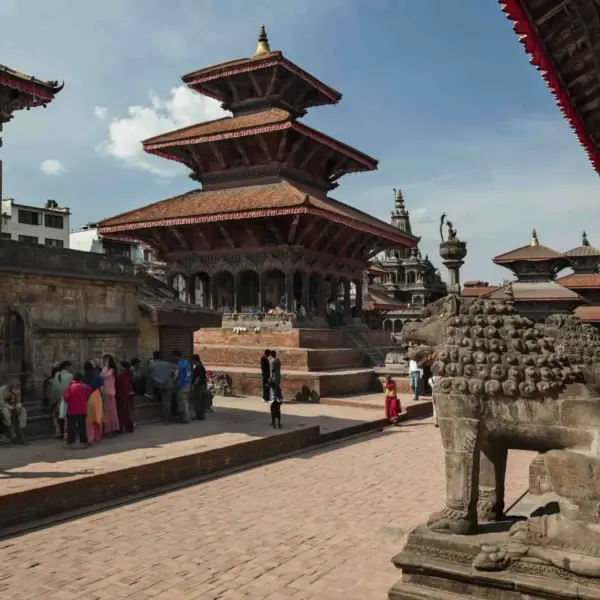
This trip starts in Kathmandu, where some of the most significant heritage sites of the city are visited, such as Kathmandu Durbar Square, Swayambhunath, Pashupatinath and Boudhanath. The visit to Patan and Bhaktapur provides further knowledge of the traditional architecture and art of the Kathmandu Valley. You also have time to see the bustling streets, the local market and restaurants of Kathmandu before heading towards Tibet.
Then it’s a flight from Kathmandu to Lhasa. At (3,650 m / 11,975 ft), Lhasa is quite high compared to Kathmandu, so there is time to acclimatise to the altitude once you reach Lhasa. The Tibet section will concentrate on the cultural and religious aspects of Tibet. The tour to Potala Palace, Sera Monastery, Norbulingka, Drepung Monastery, Jokhang Temple and the Barkhor area will be made. There are also chances to learn about Tibetan Buddhism, Tibetan history and Tibetan architecture at these sites and to enjoy the unique scenery of the Tibetan plateau.
On return to Kathmandu, the tour is extended to Bhutan. The flight to Paro is to another area of the Himalayas, where the high plateau of Tibet is replaced by forested valleys and mountain scenery. The next destination from Paro is Thimphu, where you will be able to visit cultural institutions, monasteries, traditional craft centres and other important places in the capital.
The Bhutan section also visits the Paro Taktsang, also known as Tiger’s Nest. This monastery is located at about 3,120 m / 10,236 ft) and can be accessed through a mountain trail. This walk is up and down hills and some steps, so fitness and comfortable walking shoes are helpful. The route will be different from the city sightseeing available on the trip.
The trip is suitable for people who want to experience other sides of the Himalayas in a combination of Nepal, Tibet and Bhutan. Nepal offers historic cities and Hindu and Buddhist heritage, Tibet offers high-altitude landscapes and Tibetan Buddhist culture and Bhutan offers traditional architecture, monasteries and mountain valleys.
The trip is primarily a cultural trip and not a multi-day trek and involves flights and road transfers. This enables you to visit several important destinations in the Himalayas in 11 days. My Everest Trip will provide all the arrangements necessary for the trip, including transportation, accommodation, permits and local assistance to travel from Nepal to Tibet and back to Bhutan based on the confirmed itinerary.
Why This Trip Is Special
The Nepal Tibet Bhutan Tour is a combination of three different places in the Himalayas. Rather than visiting a single country, you get to see the historic cities and religious sites of Nepal, the high plateau and Buddhist tradition of Tibet and the traditional culture and mountain valleys of Bhutan.
The Nepal Tibet Bhutan Itinerary also helps to distinguish each of the destinations from each other. Kathmandu’s ancient temples and historic squares will be introduced to you; Lhasa shows you some of the important places like Potala Palace and Jokhang Temple; and Bhutan is the place where you’ll experience the hike to the Tiger’s Nest and Paro, Thimphu and other important places.
Another benefit is that you don’t need to be committed to a long trek to enjoy all the experiences. The trip includes a day hike, road trips, cultural sightseeing, scenic flying and visiting monasteries and heritage sites.
Travellers seeking a more expansive view of the Himalayas will appreciate the chance to visit three other neighboring countries and view their own traditions, architecture and landscapes.
Nepal Tibet Bhutan Tour Itinerary
Day 01: Arrival in Kathmandu, Nepal
Your Nepal Tibet Bhutan Tour starts when you arrive at Tribhuvan International Airport in Kathmandu. Our representative will meet you at the airport and transfer you to your hotel. The duration of the drive from the airport to the main hotel areas in Kathmandu is approximately 20 to 30 minutes, depending on the traffic.
Once you have arrived, you may be able to take some time to rest following your flight. Today is a no-tour day, which makes it a fairly easy day as it allows you to get comfortable and get acquainted with the city before starting to see the sights.
The altitude concern is not significant in Kathmandu as the elevation is approximately 1400 m (4593 ft). Your guide or representative can also brief you on what’s to happen on the next days and assist you to make arrangements, if any, before you go to Tibet.
The meal will be served at the hotel. Overnight stay in Kathmandu, which will be used to prepare the Kathmandu sightseeing program for the next day.

Dinner

Hotel

6 km

1,400 m / 4,593 ft

Airport pickup and hotel transfer
Day 02: Explore Kathmandu, Nepal
This is a day dedicated to cultural sightseeing in Kathmandu and Patan. The first part of the day is the Kathmandu Durbar Square area of Kathmandu Valley, which is the former royal palace area. You will also visit the Kumari temple, which is the traditional home of the Kumari (the living goddess of Nepal).
Next on the tour is Swayambhunath, a Buddhist stupa perched on a hilltop above the Kathmandu Valley. Here you can enjoy an open panorama of Kathmandu, in good weather.
You will visit Patan Durbar Square and Lalitpur in the afternoon. The visit comprises visits to the Golden Temple, Krishna Temple and Patan Museum. These sites showcase the architecture, religions and art of Kathmandu Valley.
Most of the day is devoted to sightseeing and the journey to the various sites varies by traffic conditions. After the tour, you will return to your hotel in Kathmandu.
Breakfast, Dinner
Hotel
20 km of local sightseeing by road
1,400 m / 4,593 ft
Cultural sightseeing in Kathmandu and Patan
Day 03: Fly from Kathmandu, Nepal to Lhasa, Tibet, China
You will then go to Tribhuvan International Airport for your flight to Lhasa after breakfast. The flight flies over the Himalayan region before landing at Lhasa Gonggar Airport in Tibet.
Upon arrival at the airport, you will take a vehicle from Gonggar Airport to Lhasa after completing formalities at the airport. Travel time is approximately 1-1.5 hours by road, depending on traffic and road conditions. Lhasa is located at approximately 3650 m (11975 ft) up from Kathmandu.
The remainder of the day is spent acclimatising. Excessive exercise and giving your body a chance to adapt to the increase in elevation are recommended. Hydration and sufficient rest are beneficial on the first day in Lhasa.
The route to Lhasa is through the valleys of the land and the first impression of the Tibetan land is made during the drive. Once you have arrived at the hotel, you are able to unwind and avoid the rest of the evening’s noise.
The hotel will serve dinner. You will spend the night in Lhasa.
Breakfast, Dinner
Hotel
60 km by road from Gonggar Airport to Lhasa
3,650 m / 11,975 ft
Flight to Tibet, airport transfer and acclimatization
Day 04: Explore Lhasa, Tibet
After breakfast, you embark on a sightseeing tour of Lhasa today. The first stop is the former winter residence of the Dalai Lamas, the Potala Palace. The palace is a significant historical and religious place and houses many halls, chapels, religious items and traditional paintings.
You’ll tour the palace area, followed by visits to Sera Monastery and Norbulingka. Sera is renowned for its Tibetan Buddhist practices and monastic life. Norbulingka served as the summer residence of the Dalai Lamas and features buildings, religious structures and gardens.
There’s a little walking around the historic sites and up some steps, so it’s practical to take a leisurely pace at this height. The city of Lhasa is located at approximately 3650m (11975ft) and certain areas on the day trip can be slightly higher.
The second day is another full day to acclimatize yourself to the mountains and to get to know some of the history and religious heritage of Tibet. Once you have seen around, you will head back to your hotel for an evening meal and overnight stay.
Breakfast, Dinner
Hotel
Approx. 20 km of local sightseeing by road
3,750 m / 12,303 ft
Cultural and historical sightseeing in Lhasa
Day 05: Explore Lhasa
On the second full day of sightseeing in Lhasa, you will visit the Barkhor area, Jokhang Temple and the Drepung Monastery. Then, you will travel to Drepung Monastery, one of the biggest Tibetan Buddhist monasteries, which was established in the 15th century. It became a significant place of Buddhist studies and, at one time, had a large number of monks.
The afternoon is spent wandering around the Jokhang Temple, one of the main temples of Lhasa. Barkhor surrounding area is also an important part of Tibetan life, where religious and business activities take place on a daily basis. There will be time to explore the area and enjoy the local ambience and traditional streets and shops.
Since Lhasa is at a high elevation, you should explore it at a moderate pace. If necessary, rest frequently, during the transition between buildings or steps.
Once the sightseeing is done, you’ll head back to your hotel. In the evening, dinner will be held and the following night will be spent again in Lhasa.
Breakfast, Dinner
Hotel
Approx. 15 to 20 km of local sightseeing by road
3,800 m / 12,467 ft
Monastery, temple and market sightseeing
Day 06: Fly back to Kathmandu and explore Kathmandu
Breakfast will be served, after which you will head to the airport for your return flight from Lhasa to Kathmandu. The flight returns to the lower elevation of the Kathmandu Valley from the high plateau of Tibet.
On arrival in Kathmandu, you will proceed to visit Pashupatinath Temple and Boudhanath Stupa as part of the sightseeing program. An important pilgrimage site of the Hindu faith, Pashupatinath is situated adjacent to the Bagmati River. Boudhanath is also the central stupa of the Kathmandu Valley and one of the most important centres of the Tibetan Buddhist communities in the valley.
This afternoon you will head back to Bhaktapur Durbar Square. Within the historic square are found temples, courtyards and traditional Newari architecture. Actual time at each site may be altered based on traffic, opening schedule and flight schedule.
There is also a significant change in elevation on the return flight to Kathmandu. The day is about 1400 m (4593 ft) lower than your previous days in Lhasa.
Breakfast, Dinner
Hotel
Approx. 30 km of local sightseeing and transfers
1,400 m / 4,593 ft
Flight to Kathmandu and cultural sightseeing
Day 07: Fly from Kathmandu, Nepal to Paro, Bhutan
After breakfast, you will proceed to Tribhuvan International Airport for your flight to Paro, Bhutan. The clear-day flight offers a view of the Himalayas on the way and towards Paro.
Upon arrival at Paro International Airport (2,235 m or 7,333 ft), the arrival formalities are to be completed and the local representative will be met. Then, you’ll head to your hotel in Paro.
The rest of the day can be a relatively easy one, depending on the time of arrival. This is a chance for you to get settled in Bhutan and get a restful night’s sleep before the road trip and sightseeing program of the next two days.
Paro is nestled in a valley, surrounded by forested hills and mountains. The town also has a number of significant cultural sites, but the primary sightseeing program will be done later in the tour.
Breakfast, lunch and dinner will be provided during the day and you will be staying overnight in a hotel in Paro.
Breakfast, Lunch, Dinner
Hotel
Approx. 10 km by road after arrival, depending on hotel location
2,235 m / 7,333 ft
Flight from Kathmandu to Paro and hotel transfer
Day 08: Drive from Paro to Thimphu
Following breakfast, you will be driven from Paro to Thimphu, the capital of Bhutan. The distance is about 50 kms and takes about 1.5 to 2 hours, depending on the traffic, weather and stops.
The sightseeing program starts in Thimphu, where there are a number of sites related to Bhutanese culture and daily life. The traditional arts of Bhutan will be taught at the Arts and Crafts School and the Traditional Medicine Institute will be visited. The other significant place to visit in the city is Tashichho Dzong.
Other attractions on the route are the traditional paper factory, the Handicrafts Emporium, the Botanical Garden and the King Jigme Dorji Memorial Chorten. You can also visit the weekend market, which offers a range of products from local farmers and traders if your visit is during the weekend.
The National Library is part of the Thimphu sightseeing programme. Hence, it was more suitable to be observed on this day than on the Paro day since the National Library is situated in Thimphu.
Overnight stay in Thimphu’s Hotel.
Breakfast, Lunch, Dinner
Hotel
Around 6 to 8 hours including drive and sightseeing
2,334 m / 7,657 ft
Drive to Thimphu and cultural sightseeing
Day 09: Drive from Thimphu to Paro and Explore Paro
Following breakfast, drive to Paro. The route is about 50 km long and takes about 1.5 to 2 hours.
After arriving in Paro, there is a sightseeing program about the Taktsang area (also known as Tiger’s Nest) and Ta Dzong (National Museum of Bhutan). Ta Dzong was originally built as a watchtower and now houses the National Museum. There will also be opportunities to explore local workshops and handicraft shops.
This trip to Taktsang is more of a trek than a road trip to the monastery. The monastery sits at an altitude of approximately 3120 m (10236 ft) and the round trip usually takes about 5 to 6 hours, depending on walking speed and the time spent at the monastery.
There will be hiking up and down the trail, so good hiking boots and water are essential. Once back at Paro, you will be able to rest up before dinner and the night’s accommodation.
Breakfast, Lunch, Dinner
Hotel
Approx. 50 km by road plus the Tiger's Nest walking route
3,120 m / 10,236 ft
Drive from Thimphu to Paro and Tiger's Nest sightseeing and hike
Day 10: Fly back to Kathmandu, Nepal
After breakfast, transfer to Paro International Airport for the flight. The route will start from Bhutan and end in Nepal; the flying path may vary depending on the confirmed flight from the particular airline and operating schedule.
Weather permitting, the flight will offer glimpses of the Himalayan range. From Tribhuvan International Airport, you’ll get a transfer to your Kathmandu hotel.
The rest of the day can be enjoyed at your own pace, relaxing or exploring the city. As the primary tourist programme in Kathmandu has already been completed, the following hours are ideal for personal shopping, a walk around the local area, or just a day at the hotel.
Kathmandu is about 1400m (4593ft), much lower than Lhasa and the high places seen in Bhutan. This makes the return to Nepal a gradual change back to a lower elevation.
A dinner will be arranged and you will spend your last night in Kathmandu.
Breakfast, Dinner
Hotel
Approx. 6 km by road from the airport to the hotel, depending on hotel
1,400 m / 4,593 ft
Flight from Paro to Kathmandu and free time
Day 11: Departure
Today concludes your trip to Nepal, Tibet and Bhutan. After breakfast you will check out from the hotel and then be picked up by a private vehicle to depart from Tribhuvan International Airport to fly to your next destination.
Our representative will book your transfer to the airport as per your confirmed time of departure. The recommended time of arrival at the airport is three hours before the flight, which includes check-in, airport procedures and security.
No plans for sightseeing today, so early morning activities will be set up according to flight time. If you are leaving later during the day, you may have a bit of free time before you leave the hotel (depending on the hotel’s check-out times).
The airport is located at an approximate height of 1338 m (4390 ft) (lower than the standard height of central Kathmandu).
Once you’ve arrived at the airport, your tour is over. After passing airport formalities, you will proceed on your onward journey.
Breakfast
Around 20 to 30 minutes by road
1,338 m / 4,390 ft
Hotel checkout and airport transfer
What To Expect?
What's Included
- Accommodation in hotels in Kathmandu, Lhasa, Paro and Thimphu as mentioned in the itinerary.
- Meals as mentioned in the itinerary, including breakfast throughout the tour, dinner on the scheduled days and lunch during the Bhutan section
- All transfers to and from the airport in private vehicles and from the airport to the hotel
- Private transportation for sightseeing and overland journeys in Nepal, Tibet and Bhutan
- Domestic and regional flights included in the itinerary, including Kathmandu to Lhasa, Lhasa to Kathmandu, Kathmandu to Paro and Paro to Kathmandu
- English-speaking local guides for sightseeing and cultural visits. French, Italian, German, Spanish, Japanese, Russian and Chinese guides are available, free of charge and on request when available.
- Entrance fees to the monuments, monasteries, temples and heritage sites mentioned in the itinerary
- Tibet Travel Permit and other required Tibet travel documentation for the confirmed itinerary
- Bhutan visa or applicable entry permit arrangements for eligible travellers
- Necessary Bhutan travel permits and documentation for the confirmed itinerary
- Sightseeing tours as mentioned in the itinerary
- Airport assistance and transfers on arrival and departure
- Government taxes and service charges for services included in the price
What's Excluded
- International airfare to and from Nepal
- Nepal tourist visa fee
- Travel insurance including medical treatment, emergency evacuation and trip cancellation cover.
- Personal expenses such as laundry, telephone calls, internet charges and shopping
- Beverages, including alcoholic and bottled drinks not specifically included in the meal plan
- Additional charges for the airline’s use (such as excess baggage) and other personal charges of the airline
- Tips for guides, drivers and other service staff
- Any optional sightseeing, activities or excursions not mentioned in the itinerary
- Additional hotel accommodation caused by early arrival, late departure, flight changes or itinerary changes
- Meals and accommodation not specifically mentioned in the itinerary
- Flight delays, cancellations due to weather or other factors outside of the organiser’s control will result in personal expenses.
- Any additional permits or government fees required because of changes to the itinerary or travel to destinations not included in the standard program
- Costs arising from illness, injury, medical treatment or emergency evacuation
- Any service not specifically mentioned under What’s Included

Tripadvisor Reviews








Google Reviews


Nepal Tibet Bhutan Tour Additional Information
Best Time for the Nepal Tibet Bhutan Tour
The optimum time varies according to the type of sightseeing desired and the amount of rain and cold weather one desires to avoid. The weather is not necessarily the same in Nepal, Tibet and Bhutan, as this trip includes all three regions.
Spring, from March to May, is a useful period for this journey. The weather in Kathmandu is generally fine; in Tibet, as winter comes to an end, it becomes more comfortable and in Bhutan, it is spring. April and early May are ideal times to visit the area for sightseeing.
Autumn, from September to November, is another practical period. Following the monsoon, Nepal and Bhutan become drier and Tibet generally has clear and dry weather. October and November are good months for visitors looking for pleasant conditions for sightseeing.
Summer is wetter in Nepal and Bhutan because of the monsoon, while Tibet is generally much drier. In the winter, the weather cools, especially in Lhasa.
| Month | Nepal | Tibet | Bhutan | Overall Travel Conditions |
| January | Cool and mostly dry | Very cold | Cold | Suitable with warm clothing |
| February | Cool | Very cold | Cold | Possible but cold |
| March | Mild | Cold to mild | Spring begins | Good |
| April | Mild and dry | Comfortable | Pleasant | Very good |
| May | Warm | Mild | Warm | Good, especially early May |
| June | Monsoon begins | Generally dry | Rain increases | Mixed |
| July | Wet | Generally dry | Wet | Better for Tibet |
| August | Wet | Generally dry | Wet | Possible with flexibility |
| September | Rain decreases | Dry | Rain decreases | Good later in month |
| October | Dry and mild | Dry and clear | Pleasant | Very good |
| November | Cool and dry | Cold and clear | Cool and dry | Very good |
| December | Cool | Very cold | Cold | Good for winter travellers |
For most travellers, April, May, October and November provide a good balance between weather and sightseeing conditions. Naturally, weather can still be a factor in flight schedules and some flexibility is useful.
Altitude and Acclimatization
Altitude plays a significant role in this journey, as there are significant differences in elevation between Nepal, Tibet and Bhutan. Kathmandu is around (1,400 m / 4,593 ft), while Lhasa is around (3,650 m / 11,975 ft).
The high-altitude flight between Kathmandu and Lhasa involves a quick change in altitude that can cause problems. That is why the first day in Lhasa is dedicated to resting and getting used to the city.
| Location | Elevation | Altitude Consideration |
| Kathmandu | (1,400 m / 4,593 ft) | Moderate elevation |
| Lhasa | (3,650 m / 11,975 ft) | High altitude |
| Lhasa sightseeing areas | Up to around (3,800 m / 12,467 ft) | Extra care required |
| Paro | (2,235 m / 7,333 ft) | Moderate elevation |
| Thimphu | (2,334 m / 7,657 ft) | Moderate elevation |
| Tiger’s Nest | (3,120 m / 10,236 ft) | High walking elevation |
Headache, dizziness, fatigue, nausea and decreased appetite are common symptoms of altitude sickness. If symptoms are getting worse, the individual should tell the guide and not attempt to go on with the planned activities.
On the first day in Tibet, take it easy and don’t perform unnecessary exercise. Drink water as usual, take light meals if appetite is decreased and rest as normal.
The latter part of the Bhutan trek also features a trek to Tiger’s Nest (3,120 m / 10,236 ft). This is less than Lhasa, but the ascent and steps might be challenging.
The Nepal Tibet Bhutan Itinerary is designed to give people the best of these changes without having to undertake a lengthy trek to the highlands. It’s still important to walk at a leisurely pace.
Visa and Entry Requirements for Nepal, Tibet and Bhutan
It’s a three-stop trip to three different immigration points. Please note that the requirements apply to the documents of travellers and may vary based on the country of origin and the precise route.
Tourist Visa on arrival at Tribhuvan International Airport is available for eligible nationalities in Nepal. In addition, travellers may apply for a visa in advance at a Nepali diplomatic mission. The new Department of Immigration offers tourist visas with a duration of 15 days, 30 days and 90 days. Some nationalities must obtain their visa before travelling to Nepal.
There are some other travel regulations for foreign tourists in Tibet. Visitors to Tibet must have the relevant Tibet travel documents and adhere to the current Chinese visa regulations for entry into Tibet. The documentation is typically acquired via an authorized Tibet travel service instead of directly.
There is also an entry system in Bhutan. Visitors from most countries have to obtain a visa before travelling and there are special procedures for visitors from India, Bangladesh and the Maldives. Bhutan offers visa applications via the internet or through a certified tour operator/hotel.
Your passport should be valid for the required time and should have sufficient space for immigration if needed. Have both a printout and digital copies of important documents.
Legislation may change, so people should seek advice on their respective country’s requirements prior to leaving home.
Tibet Travel Permit and Required Documents
Tibet approves a special travel policy for foreign tourists. For the regular Lhasa trip, the most important document to obtain is the Tibet Travel Permit. This document is prepared before one enters Tibet and is inspected when traveling.
Specifics of the documentation may vary based on the locations in the trip. With a standard Lhasa sightseeing tour, no permit arrangement is required, unlike for a trip to Mount Kailash, Ngari, or some border regions.
This Nepal Tibet Bhutan Tour emphasizes visiting Lhasa and its main cultural attractions. My Everest Trip will arrange the relevant Tibet travel permits and necessary documents based on your nationality and itinerary.
| Permit or Document | Standard Lhasa Tour | Purpose |
| Tibet Travel Permit | Required | Main permit for foreign travellers entering Tibet |
| Chinese visa or applicable entry document | Depends on nationality and current rules | Entry into China |
| Aliens’ Travel Permit | Not normally required for this route | Required for certain restricted areas |
| Military Area Entry Permit | Not normally required | Required for specific restricted areas |
| Border Permit | Not normally required | Required for selected border destinations |
| Valid passport | Required | Immigration identification |
| Confirmed itinerary | Required | Supports travel and permit arrangements |
Depending on the itinerary, some further permits may be required to visit the restricted areas in Tibet. The organiser agrees to confirm any extension provided that the requirements are met before it is confirmed.
The travellers are advised to include the information on their passports correctly, as the permit information should be the same. If there are any alterations to the path once it is agreed to proceed, this must also be agreed with the organiser.
Bhutan Visa and Tourism Requirements
Bhutan has a visa and entry process which is different from Nepal and Tibet. Most tourists visiting Bhutan require a visa before coming and citizens from India must obtain a permit and citizens from the Maldives and Bangladesh must carefully follow the procedure for a Bhutan visa.
According to the official website of Bhutan tourism, the majority of visitors can apply online, while a registered tour operator or hotel can also apply on behalf of visitors. The application must include a copy of the passport, a recent digital photograph and travel dates.
In addition to this, the Sustainable Development Fee is included as part of the Bhutan entry process within the context of Bhutan’s current tourism system. This section does not include the amount intentionally, as it focuses on the travel needs, not the price.
| Document or Requirement | Purpose | Applies to This Tour |
| Bhutan visa | Entry permission for most international visitors | Yes |
| Passport | Immigration identification | Yes |
| Digital passport photograph | Visa application | Yes |
| Travel dates | Visa processing | Yes |
| Accommodation details | Travel documentation | Yes |
| Sustainable Development Fee arrangement | Current Bhutan tourism requirement | Applicable according to nationality |
| Entry permit | Used instead of a standard visa for certain nationalities | Depends on nationality |
Please note that My Everest Trip can arrange the appropriate Bhutan visa and travel documentation as part of the tour arrangements.
Passport information should be given in the same manner as it is listed on the traveller’s travel document. Ensure that you have a copy of the approved visa or permit with all travel documentation.
For now, Bhutan says it takes as long as five working days to process visa applications that are submitted correctly; hence, it is advised to avoid submitting applications at the last minute.
Flights and Transportation Between Destinations
An important element of this trip is transportation – this will include private road transfers, walking, sightseeing vehicles and international flights.
Major air routes include Kathmandu-Lhasa, Lhasa-Kathmandu, Kathmandu-Paro and Paro-Kathmandu. Flight times and timetables are dependent on airline operations, travel dates and weather.
| Route | Transport | Approximate Time | Main Information |
| Kathmandu Airport to hotel | Private vehicle | 20 to 30 minutes | Traffic can affect timing |
| Kathmandu sightseeing | Vehicle and walking | Full day | City traffic can be heavy |
| Kathmandu to Lhasa | Flight | Around 1.5 to 2 hours | Schedule depends on airline |
| Gonggar Airport to Lhasa | Private vehicle | Around 1 to 1.5 hours | High altitude begins immediately |
| Lhasa sightseeing | Vehicle and walking | Full day | Slow walking is recommended |
| Lhasa to Kathmandu | Flight | Around 1.5 to 2 hours | Weather may affect schedules |
| Kathmandu to Paro | Flight | Around 1 hour | Himalayan flight route |
| Paro to Thimphu | Private vehicle | Around 1.5 to 2 hours | Mountain road |
| Thimphu to Paro | Private vehicle | Around 1.5 to 2 hours | Mountain road |
| Paro to Tiger’s Nest | Vehicle and hiking | Full day | Walking required |
| Paro to Kathmandu | Flight | Around 1 hour | Subject to airline schedule |
Paro to Thimphu road trip is approximately 50 km, but mountain roads may take more time than anticipated due to turns, uphill and downhill terrain, traffic and weather conditions.
In addition to low visibility, weather in the Himalayan region can also impact flights. This is why travellers should not make very tight connections after regional flights.
The exact amount of baggage allowed may vary by airline on your confirmed flight. Check your ticket before packing.
Weather Across Nepal, Tibet and Bhutan
There are significant differences in the weather between the three destinations. The climate of Kathmandu is relatively mild in the valley, the climate of Lhasa is a high-altitude plateau climate and the climate of Bhutan has large regional variations due to the different levels of elevation.
| Season | Nepal | Tibet | Bhutan | What to Expect |
| Spring | Mild to warm | Cold to mild | Mild and pleasant | Good sightseeing conditions |
| Summer | Monsoon rain | Generally dry | Monsoon rain | Flexible travel useful |
| Autumn | Dry and mild | Dry and clear | Generally clear | Very good period |
| Winter | Cool and dry | Very cold | Cold | Warm clothing required |
Due to its elevation, Lhasa can be much cooler than Kathmandu. Daytime sunshine can be intense and night-time temperatures can drop sharply after dark.
Bhutan is a country with a diverse climate. In the mornings and evenings, especially during winter, Paro and Thimphu may be chilly.
Kathmandu can become warm during spring and autumn, while summer brings regular rainfall.
Layering up in different clothing is helpful for the Nepal Tibet Bhutan Travel experience, as you’ll experience drastically different temperatures in a matter of moments.
A waterproof jacket can be helpful in the monsoon season. For winter travelling and crossing Tibet, a warm and insulated jacket is more important.
In Tibet, where strong sunlight is prevalent at higher elevations, good sunglasses and sunscreen are helpful.
Accommodation During the Tour
Sleeping in a hotel is provided in Kathmandu, Lhasa, Paro and Thimphu. This is a cultural sightseeing tour and the place to stay is the same as that of a sightseeing tour and not a trekking tour where travellers stay in the mountain teahouses.
Confirmed package and availability will dictate the exact hotels. Facilities may also differ from one hotel to another at a particular location.
| Facility | Kathmandu | Lhasa | Bhutan |
| Private room | Usually available | Usually available | Usually available |
| Private bathroom | Usually available | Usually available | Usually available |
| Hot water | Generally available | Generally available | Generally available |
| Heating | Seasonal | Important in winter | Important in colder months |
| Wi Fi | Common | Available with restrictions | Common |
| Restaurant | Widely available | Widely available | Available |
| Laundry | Available at many hotels | Available at larger hotels | Available at selected hotels |
The most diverse hotels and restaurants are available in Kathmandu.
During winter time, heating may become crucial in Lhasa due to the high altitude. There are also features that may differ from what one is used to at home that are found at some facilities.
Bhutan has opened accommodation facilities, ranging from hotel classes and locations.
For those who require a double room, twin room, or other accommodation, please ask before travelling.
It is also advisable to store passports, currency and essential documents in a safe location as well.
Food, Drinking Water and Dietary Needs
Food is different along the way and travelers will enjoy eating Nepali, Tibetan and Bhutanese cuisine.
Dal bhat, momo, noodles, rice dishes, curry and international food are available in Kathmandu. There is plenty of vegetarian food.
Typically, Tibetan dishes feature dumplings, rice, noodles, Tibetan bread, vegetables and soups. Outside of the tourist centres, the range of food choices may be more restricted.
Typical favourite foods of Bhutan are rice, vegetables, chilli and cheese-based food. Hotels for foreigners typically offer extra options.
| Destination | Common Foods | Vegetarian Choices |
| Nepal | Dal bhat, momo, noodles, rice and curries | Widely available |
| Tibet | Noodles, dumplings, rice and soups | Available |
| Bhutan | Rice, vegetables and chilli-based dishes | Widely available |
Please advise the organiser if you are allergic to any food or have a dietary restriction. Also, if you have more serious allergies, they should be communicated clearly to the staff at the restaurant.
Most overseas visitors will prefer to drink bottled water or properly treated water for drinking purposes. Don’t drink untreated water from natural sources such as streams.
A reusable bottle might come in handy throughout the trip. A water purification method can be taken as a secondary option as well.
At high altitude, it is possible to experience a loss of appetite. The first few days in Tibet will be more comfortable if you eat smaller meals and familiar foods.
Internet, Mobile Network and SIM Cards
Internet connectivity is fairly decent in Kathmandu and cities of Bhutan, but it is not as reliable in remote areas. Unlike other places, Tibet is not free from internet regulations and restrictions of the mainland Chinese government.
Not all websites, applications, or social media platforms that are available in Nepal will function as usual in Tibet.
Important information should be backed up on the ground before it is sent to Lhasa. Hotel information, flight details, passport copies, contact numbers in case of any emergencies and the itinerary must be available even without an internet connection.
| Destination | Mobile Network | Hotel Internet | Main Consideration |
| Kathmandu | Good in urban areas | Widely available | Generally easy |
| Lhasa | Available | Available in many hotels | Restrictions apply |
| Paro | Good in town | Common | Coverage varies outside town |
| Thimphu | Good | Common | Better in city areas |
| Mountain roads | Variable | Limited | Offline information useful |
Nepal and Bhutan have local SIM options, subject to current registration requirements.
You should unlock your phone before you insert a local SIM if you plan to use a local SIM. If your device and provider support it, you might also want to consider an eSIM.
Don’t navigate solely by mobile internet. Save hotel information (names, addresses and key contacts) offline.
A power bank is useful because sightseeing days can be long and charging may not always be convenient while travelling.
Currency, Money and Payment Methods
On this journey, you will have to use various currencies. Nepal uses the Nepalese Rupee, Tibet uses the Chinese Yuan and Bhutan uses the Ngultrum.
Before travelling from one country to another, it’s better to arrange your finances beforehand, as the Nepalese Rupee is not an effective alternative to local currency in Tibet or Bhutan.
| Destination | Currency | Useful Information |
| Nepal | Nepalese Rupee | Cash widely used |
| Tibet | Chinese Yuan | Local currency for daily purchases |
| Bhutan | Ngultrum | Main national currency |
| Bhutan | Indian Rupee | Accepted in many situations, subject to restrictions |
Larger hotels and businesses will typically accept credit and debit cards; cash is still a good option for smaller items.
The official information about Bhutan tourism advises you to check with your bank about whether your card is compatible with international use.
In Tibet, Chinese payment systems are widely used by local citizens. Foreign visitors cannot just rely on mobile payment apps.
Put your emergency cash anywhere apart from your wallet. It is also sensible to keep some smaller notes for minor purchases and tips.
Contact your bank before leaving if you need to and ensure that your card is international.
Local Customs, Dress Code and Cultural Etiquette
Nepal, Tibet and Bhutan have strong religious traditions, so respectful behaviour is important when visiting temples, monasteries, dzongs and other sacred places.
When entering religious buildings, dress in a modest fashion. In monasteries and temples, generally shoulders and knees should be covered, especially in the presence of the monks.
There are different rules for different photography sites. Do not take pictures of religious ceremonies, monks, or individuals without permission.
Important Cultural Points
- Wear modest attire at religious institutions.
- Don’t take photos of people without their consent.
- Obey indications and directions in monasteries and temples.
- Respect religious objects and statues; do not touch without permission.
- Don’t have a loud discussion within a religious building.
- Follow directions for walking around religious sites of the Buddha when directed to do so.
- Stay out of restricted areas.
- Avoid disturbing religious ceremonies.
- Don’t take away religious items or cultural artifacts.
- Maintain natural areas and heritage sites as clean as possible.
The Bhutan Government has given special guidelines to visitors urging them to respect sacred sites, local culture and the environment.
Monasteries and temples are active religious centers in Tibet. Hence, visitors should act as guests and not merely as sites for sightseeing.
There are also religious centers in Kathmandu with varying rules. Entry to some portions of Hindu temples is barred to non-Hindus.
In Bhutanese dzongs, always follow the instructions of the guide and local staff, as it is a building that may serve administrative and religious purposes.
Tiger’s Nest Hike: Difficulty and Preparation
Tiger’s Nest, also called Paro Taktsang, is reached by a walking trail from the Paro Valley. Visitors can be taken only by car to the monastery.
The monastery is at around 3,120 m / 10,236 ft). According to Bhutan’s official tourism information, the walk is a level climb and it will take about 2 hours to reach the monastery area, which may take longer depending on your pace and rest stops.
| Factor | Information |
| Location | Paro Valley |
| Starting point | Tiger’s Nest trail area |
| Monastery elevation | (3,120 m / 10,236 ft) |
| Activity | Hiking |
| Difficulty | Moderate |
| Main challenge | Uphill walking and stairs. |
| Ascent time | Around 2 hours to the monastery area |
| Total walking time | Often around 5 to 6 hours |
| Trail | Forest path, mountain trail and stairs |
| Technical climbing | Not required |
| Footwear | Comfortable walking shoes |
| Water | Carry sufficient drinking water. |
| Clothing | Light layers and a warm layer |
The path is not a technical climbing path, but it calls for continuous ascent. There are also downhill sections on the return ride and stairs.
It’s not about speed; it’s about a comfortable pace. Rent time out as needed and give yourself plenty of time to do the hike without rushing.
Use a small daypack for water, snacks, sunscreen, a jacket and personal meds.
Given the altitude of the trail, it is recommended that visitors who have newly arrived in Bhutan should assess their condition before embarking on the trail.
Health, Travel Insurance and Safety
Good preparation helps make the journey more comfortable. Bring sufficient prescription drugs and drugs in their original containers.
If you suffer from a medical condition, please consult your physician before you travel, especially as you will be hiking up to Lhasa (3,650 m / 11,975 ft) and up to the Tiger’s Nest (3,120 m / 10,236 ft).
Health and Safety Points
- Always bring medication in your hand luggage.
- Have copies of prescriptions available.
- Drink safe water.
- Wash hands frequently.
- Apply sun cream and sunglasses at high altitudes.
- Take your time on your first day in Lhasa.
- Let your guide know about signs of altitude sickness.
- Please wear appropriate footwear for Tiger’s Nest.
- Obey traffic signs and signals.
- Have emergency phone numbers available.
Travel insurance should provide coverage for the entire trip as well as the three places. Review your policy to see if there is coverage for medical treatment, emergency evacuation, trip cancellation and flight delay or activities at higher elevations.
| Insurance Coverage | Why It Is Useful |
| Medical treatment | Covers eligible medical expenses |
| Emergency evacuation | Important for serious illness or injury |
| Trip cancellation | Protection against covered cancellation |
| Trip interruption | Useful if the journey must end early |
| Flight delay | Useful during weather-related disruptions |
| Lost baggage | Helps with eligible baggage claims |
| High altitude | Check the policy limits carefully. |
There is no technical mountaineering involved in the trip, but good preparation for the hike to the Tiger’s Nest and for the altitude is necessary.
Flights and mountain roads can be affected by the weather, so it is helpful to be flexible. Follow a guide or driver’s schedule, as changes have been made to the schedule as a result of safety conditions.
Alternative Tibet and Bhutan Tours and Travel Options
The typical tour route is to visit Lhasa, then Paro and finally Thimphu. Those with more time may want to continue their travels to other areas of Tibet and/or Bhutan.
Your choice of extension will be based on cultural sightseeing, high altitude scenery, pilgrimage, or trekking.
| Tibet Option | Main Places | Main Experience |
| Lhasa Cultural Tour | Lhasa | Palaces, temples and monasteries |
| Lhasa and Shigatse | Lhasa, Shigatse | Cultural sites and Tibetan landscapes |
| Tibet Everest Tour | Lhasa, Shigatse, Everest region | Mountain scenery |
| Yamdrok Lake Tour | Lhasa and Yamdrok | Lake and mountain landscapes |
| Mount Kailash Tour | Western Tibet | Pilgrimage and high altitude travel |
| Kailash and Manasarovar | Kailash and Manasarovar | Pilgrimage and mountain journey |
There may be other travel and permit requirements to visit other Tibet destinations, which should be confirmed prior to planning the trips.
| Bhutan Option | Main Places | Main Experience |
| Paro and Thimphu Extension | Paro, Thimphu | Cultural sightseeing |
| Punakha Tour | Punakha, Thimphu, Paro | Dzongs and valley scenery |
| Western Bhutan Tour | Paro, Thimphu, Punakha | Cultural travel |
| Druk Path Trek | Paro to Thimphu | Mountain trekking |
| Gangtey Trek | Gangtey Valley | Short trekking |
| Jomolhari Trek | High mountain region | Challenging trekking |
| Bumthang Trek | Central Bhutan | Culture and trekking |
There are various trekking routes in Bhutan with various levels of difficulty, allowing travellers to extend their stay if they have enough time for trekking and experience.
The extension can be done by trekking in Nepal in the Everest, Annapurna, or Langtang region. To add another destination, however, would require additional time for transportation, rest and additional permits.
However, for a shorter extension, booking a cultural tour of Kathmandu, Paro, or Thimphu is more straightforward than planning a trip into the mountains.
Should an additional Tibet or Bhutan location be added, the organiser must confirm the route, transportation and entry requirements at that time.
Nepal Tibet Bhutan Tour FAQs
Is it possible to tailor Nepal Tibet Bhutan Tour?
Yes, the program can be modified with extra nights, tours, special services and extensions (permitting and availability).
This tour is suitable for travellers who do not like the idea of trekking?
Yes, cultural sightseeing and road travel are a significant part of most activities and Tiger’s Nest is the one noticeable hike.
What kind of a guide is offered on sightseeing?
Sightseeing is done with local guides; English-speaking guides are available if requested and arranged.
Are there more places in Tibet that can be included in this trip?
Extensions to destinations like Mount Kailash or other restricted areas may be possible, but may require further permits and arrangements.
Should the tour be extended to Bhutan?
Yes, more destinations in Bhutan, like Punakha or trekking areas, can be included in the tour, depending on the travel time and travel arrangements.
What happens when there is a delay of a scheduled flight that goes to the Himalayan region?
The itinerary may be subject to change due to weather and/or operating conditions, which can impact regional flights, road transfers and connections.
Does the package cover international flights to Nepal?
No, the international airfare to and from Nepal is not included unless otherwise mentioned in your confirmed travel package.
Do the four regional flights count towards the package?
These flights are part of the listed itinerary but may be subject to booking passengers to confirm if the airfare is covered in their confirmed tour price.
Are there multiple choices of hotel room arrangements available?
Yes, double, twin, or other room types are available and can be requested if available at the hotel.
Who issues the travel passes for Tibet and Bhutan?
My Everest Trip can arrange the necessary permits and supporting documents for the relevant countries as per the confirmed itinerary and country of the travellers.
US$ 7,500 per person
- 24/7 Customer Support
- Experienced and Professional Team
- Hassle-Free and Easy Booking
- 99% Customer Satisfaction
- Fair Prices, Exceptional Service
- No Hidden Costs and Secure Payments
- Tailored and Personalized Itineraries
24 X 7 Live Support

Puru (+977-9851069558)
Related Trips


Recent From Our Blog Places of attractions, travel tips, news and more.
Blog
10 Interesting Facts About Nepal That Will Surprise You
Nepal is a small Himalayan country between India and China but it has an amazing…
Read the full post
Blog, Manaslu, Trekking in Nepal
12 Days Manaslu Circuit Trek Guide
Where is Mount Manaslu? which is the Best Season For a Trek? how much does…
Read the full post
Nepal, Tour In Nepal
10 Things to Know About Nepal
10 things to know about Nepal before visiting Nepal can genuinely transform your travel experience.…
Read the full post