

10 Days


Quick Facts

Private Vehicle

Hotel, Tea House

Breakfast, Lunch and Dinner

Trekking, Yoga, Pranayama, Meditation, and Sightseeing

Oct-Dec & Mar-May

Easy

Nepal

4500 m


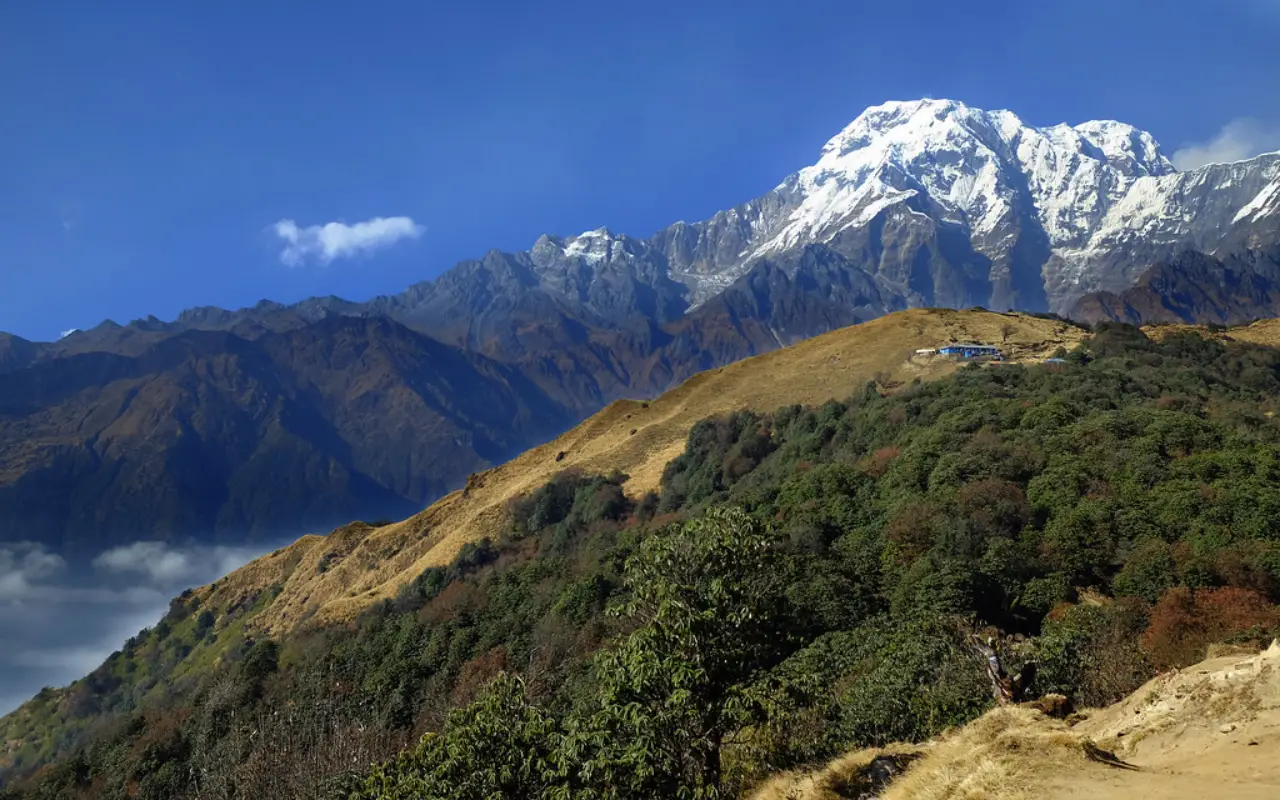

Why Mardi Himal Yoga Trek?
- Trek through the peaceful forests and rhododendron landscapes from Kande
- Join a trip to the mountains and do yoga, pranayama and meditation sessions.
- A night’s stay at the traditional tea houses on the trekking path.
- Reach High Camp at approximately 3,550 to 3,580 m / 11,647 to 11,745 ft
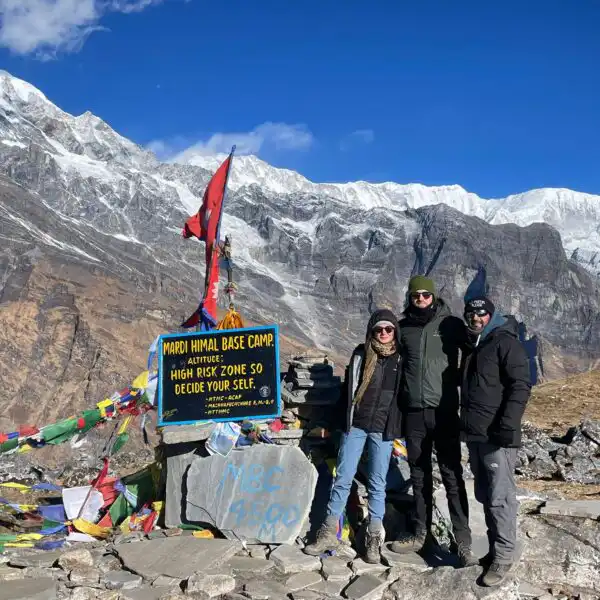
- Hike to the Mardi Himal Base Camp area, from where one can reach 4,500 m / 14,764 ft.
- Enjoy rocky and more exposed sections on the higher parts of the trail.
- Do yoga and stretching after certain trekking days
- Get to sing bowl music for wellness as a component of the wellness program.
- Once more in the forest and the farmlands, you’ll go down to Siding Village, then to Pokhara.
- Delve into trekking and health, while enjoying a tour of Kathmandu and Pokhara.
Mardi Himal Yoga Trek Overview
The Mardi Himal Yoga Trek combines mountain trekking with a structured wellness program in Nepal’s Annapurna region. The route starts in Kathmandu and ends in Pokhara, with the trekking section beginning in Kande. The trail then heads through woods, rhododendron patches, and mountain scenery as it slowly ascends to higher ground.
The trekking days include walking and wellness. Yoga sessions are held in the morning; recovery yoga, stretching, and singing-bowl sound healing take place after some trekking days. These sessions allow time for a relaxed, gentle workout alongside the physical challenge.
The Mardi Himal Trek reaches High Camp at approximately 3,550 to 3,580 m / 11,647 to 11,745 ft. The highest section of the trek is the Mardi Himal Base Camp area at around 4,500 m / 14,764 ft, which involves a long walk from High Camp, including some rocky and more exposed sections of the higher trail. Leaving the Base Camp area, you will head down towards Badal Danda (approx. 3,210 m / 10,531 ft).
You’ll also see a variety of scenery along the way. The lower sections feature forests and villages, while the upper path offers glimpses of the mountains. Once you reach Siding Village, you will drive back to Pokhara in a private jeep. Then you’ll take the tourist bus to Kathmandu.
The Mardi Himal Wellness Trek is ideal for those seeking a more-than-average walking experience. The wellness sessions do not, however, take away the trek’s physical challenges. You still have a few days of walking ahead, both uphill and downhill, plus the longer Base Camp day.
Accommodation includes three-star hotels in Kathmandu and Pokhara and tea houses during the trekking portion of the trip. Breakfast is available as per the Tour Program, and on trekking days, breakfast, lunch, and dinner are included.
The trek includes time for wellness and rest in Kathmandu and Pokhara, as well as some cultural time. My Everest Trip will arrange the services and transportation mentioned in the package. My Everest Trip will arrange trekking support and other services mentioned in the package, along with the planned transportation.
Why This Trip Is Special?
On the Mardi Himal Yoga Trek, you’ll enjoy a comfortable pace while learning to walk, practice yoga postures, and use breathing techniques in the mountains. As you trek through forests, villages, and higher mountain areas, you will also have time for yoga, pranayama, and meditation.
What makes the Mardi Himal Trek unique is that it includes wellness sessions throughout. Selected trekking days include recovery yoga, stretching, singing bowl sound healing, and morning practices to help you prepare for the day’s walk.
The highest point is about 4500 m / 14764 ft, so it is an arduous yet rewarding trip. This route also takes you through the quieter forest areas between Kande and Siding, offering a varied walking experience.
This is a perfect trek for people considering the Mardi Himal Wellness Trek, offering a balance of trekking, relaxation, beautiful mountain scenery, and time to support their well-being.
Mardi Himal Yoga Trek Itinerary
Day 01: Arrival in Kathmandu and Transfer to Hotel
You will arrive at Tribhuvan International Airport in Kathmandu, where our representative will pick you up and drive you privately to your hotel in Thamel. The drive takes 20-30 minutes and covers about 6 km.
Once you arrive at the station, you’ll have time to rest after your trip. If you feel comfortable, you can take a stroll around Thamel and get to know your immediate surroundings. You can also check your trekking equipment and have a simple local meal at your own expense.
This evening is designed to be relaxed, so your body can recuperate before the trip. Overnight stay in Kathmandu in a three-star hotel.

Hotel

6 km

1,350 m / 4,429 ft

Airport pickup, private transfer, rest and optional gentle walk, 20 to 30 minutes drive
Day 02: Drive from Kathmandu to Pokhara by Tourist Bus
In the morning, you will take a tourist bus from Kathmandu to Pokhara. It is a 200 km road trip on the Prithvi Highway. This trip usually takes about 7-9 hours but can be affected by traffic, road conditions, construction, and weather.
The route passes through hilly areas, villages, countryside, and river valleys. Rest stops will typically be provided for stretching, restroom breaks, and refreshments along the way.
Once you arrive in Pokhara, you will be welcomed at your three-star hotel. The evening is for resting or taking a gentle stroll around Lakeside. You’ll have time to get ready for the trekking and wellness experiences to come.

Breakfast
Hotel
200 km
820 m / 2,690 ft
Tourist bus drive, rest and optional gentle Lakeside walk, 7 to 9 hours by tourist bus
Day 03: Drive to Kande and Trek to Pitam Deurali
After breakfast in Pokhara, you will proceed by private vehicle to Kande, where you begin the trek. The driving time depends on your plan, but it should be about 45 minutes. In Kande, you will set off on a path that traverses forested hills and rhododendron zones.
The trail slowly ascends to reach Pitam Deurali. The walk is about 6 km (3.75 miles) and takes about 4 – 5 hours. This lets you take breaks and walk at your pace.
Pitam Deurali (2100 m/6,890 ft) is a tea house. As part of the wellness program, you will spend 45 minutes on yoga, 15 minutes on pranayama, and 10 minutes on meditation. The program includes 30 minutes of recovery yoga and stretching, followed by 45 minutes of singing bowl sound healing.
Breakfast, Lunch, Dinner
Tea House
6 km trekking
2,100 m / 6,890 ft
Drive, trekking, yoga, pranayama, meditation, recovery yoga, stretching and singing bowl sound healing, 45 minutes drive + 4 to 5 hours trek + 2 hours 25 minutes wellness activities
Day 04: Trek from Pitam Deurali to Rest Camp
We start the day with breakfast and then 45 minutes of yoga, 15 minutes of pranayama, and 10 minutes of meditation. This will help you loosen up and get ready for the day’s uphill walk.
The trail will then pass through rhododendron and other forest areas as it gradually rises in elevation. The trek is around 9 km and the walking time is around 5-6 hours. Rest Camp is located at about 2700m / 8858ft in your itinerary.
Once you arrive at the tea house, you can rest and recuperate. Then, in the evening, we have a 30-minute recovery yoga and stretching session and a 45-minute singing bowl sound healing session. Dinner and overnight stay will be in the tea house.
Breakfast, Lunch, Dinner
Tea House
9 km
2,700 m / 8,858 ft
Trekking, yoga, pranayama, meditation, recovery yoga, stretching and singing bowl sound healing, 5 to 6 hours trek + 2 hours 25 minutes wellness activities
Day 05: Trek from Rest Camp to High Camp
The morning will start with breakfast, followed by 45 minutes of yoga, 15 minutes of pranayama, and 10 minutes of meditation. After the wellness session, you’ll trek further up to High Camp.
The trail leads through timber before opening up with the mountain vistas. The walk is from 7 to 9 km, and the hike will take around 5-6 hours.
Once you arrive at High Camp, you will have lunch and check in to the tea house. The afternoon is free for rest. We will do 30 minutes of recovery yoga and stretching, 45 minutes of singing bowl sound healing, dinner, and an early night.
Breakfast, Lunch, Dinner
Tea House
7 to 9 km
3,550 m / 11,647 ft
Trekking, yoga, pranayama, meditation, recovery yoga, stretching and singing bowl sound healing, 5 to 6 hours trek + 2 hours 25 minutes wellness activities
Day 06: Hike to Mardi Himal Base Camp and Trek Down to Badal Danda
The longest and highest trek day of the trip. After waking, you’ll meditate for 10 minutes, do 15 minutes of Pranayama, and practice yoga for 45 minutes, then depart early for the higher ridge.
The path from High Camp is more open and rocky as you ascend to the Mardi Himal Base Camp area. The highest point is around 4500 m / 14,764 ft, then dropping down towards Badal Danda (3210 m / 10531 ft). The walking distance is approximately 12-14 km and walking time is approximately 7-9 hours.
The evening wellness session is kept light as this is a long day. Following the rest sessions, there will be 30 minutes of recovery yoga and stretching, and then 45 minutes of singing bowl sound healing. Overnight stays and dinner will be in a tea house.
Breakfast, Lunch, Dinner
Tea House
12 to 14 km
4,500 m / 14,764 ft
Mardi Himal Base Camp hike, descent, yoga, pranayama, meditation, recovery yoga, stretching and singing bowl sound healing, 7 to 9 hours trek + 2 hours 25 minutes wellness activities
Day 07: Trek to Siding Village and Drive to Pokhara
After breakfast at Badal Danda, you’ll enjoy 10 minutes of meditation, 15 minutes of pranayama, and 45 minutes of yoga. The session is a soft day after the previous walk, which was longer and higher.
From there, it follows a path through woodland and down to Siding Village through farmland. This walk is about 5-6 km and takes 3-4 hours. To access the Siding, go downhill from the higher Mardi Himal ridge. Along with the normal route information, the Badal Danda area is marked at approximately 3210 m / 10531 ft.
Following lunch in Siding, you will depart for Pokhara in a private jeep. The trip should take around 3 hours, depending on road and traffic conditions. Upon arrival at the hotel, you’ll receive recovery yoga, stretching, and singing bowl sound healing, followed by a delicious dinner.
Breakfast, Lunch, Dinner
Hotel
5 to 6 km
3,210 m / 10,531 ft
Yoga, pranayama, meditation, trekking, jeep drive, recovery yoga, stretching and singing bowl sound healing, 3 to 4 hours trek + approximately 3 hours drive + 2 hours 25 minutes wellness activities
Day 08: Drive from Pokhara to Kathmandu by Tourist Bus
After breakfast, you’ll take a tourist bus back to Kathmandu. The road trip is around 200 km and normally takes about 7-9 hours. Travel times may fluctuate due to traffic, road conditions, construction, and weather.
The bus travels along the main road passing through hilly areas and valleys. Usually, we stop along the way so you can stretch your legs, use the restroom, and grab food and drinks.
Upon arrival in Kathmandu, you will drop your bags at your 3-star hotel. After being on the road for so long, the evening is kept relaxed. Rest at the hotel or simply stroll around Thamel if you’re feeling adventurous.
Breakfast
Hotel
200 km
1,350 m / 4,429 ft
Tourist bus drive, rest and optional gentle walk, 7 to 9 hours by tourist bus
Day 09: Kathmandu Sightseeing and Shopping
After breakfast, the day is yours to explore and shop in Kathmandu. Depending on your interests and time, you can explore Swayambhunath, Boudhanath, Pashupatinath, Kathmandu Durbar Square, Patan Durbar Square, or Bhaktapur Durbar Square.
A full day of sightseeing typically takes 7-8 hours, depending on the number of major sightseeing spots visited. The total distance covered can change depending on the destinations chosen; the sightseeing distance you plan for your trip is about 22 km.
Lunch will be available, and you can shop around in Thamel or Asan. The schedule can be flexible, and you don’t have to rush between locations. On the last night, you will stay in Kathmandu at a three-star hotel.
Breakfast
Hotel
22 km for a full sightseeing route
1,350 m / 4,429 ft
Kathmandu sightseeing, cultural visits, shopping and relaxed walking, 7 to 8 hours
Day 10: Departure from Kathmandu
Following breakfast, you will be ready to board your international flight, based on your departure schedule. Check out of the hotel and have your passport and travel documents ready.
From the hotel in Thamel, our representative will meet you and drive you to Tribhuvan International Airport. The distance from Thamel to the airport is about 6 km, and it takes about 20-30 minutes, depending on Kathmandu traffic.
At the airport, you will complete the check-in procedure for your international flight. It’s time to end your 10-day Mardi Himal Trekking and Wellness tour. The highest elevation reached today is in Kathmandu (1,350 m / 4,429 ft).
Breakfast
6 km road transfer
1,350 m / 4,429 ft
Private airport transfer and departure, 20 to 30 minutes drive
What To Expect?
What's Included
- Private transfer to and from the airport in Kathmandu.
- 3 Star Hotel Accommodation in Kathmandu as per the itinerary.
- 3-star hotel accommodation in Pokhara.
- Accommodation in a tea house in the trekking area.
- Morning Breakfast in Kathmandu and Pokhara as arranged in the itinerary.
- Breakfast, lunch and dinner during the trekking days.
- Self-drive from Pokhara to Kande.
- Pick-up and drop-off at Siding by private jeep to Pokhara.
- Taxis for tourists from Kathmandu to Pokhara.
- Yoga, Pranayama and meditation are a part of the program.
- Yoga and stretching sessions to recover at night and during the days of the trek.
- Performing sound healing with a singing bowl as per the itinerary.
- Trekking support and services provided by My Everest Trip as confirmed in the package.
What's Excluded
- Airfare and entry visa to Nepal from abroad.
- Travel Insurance including trekking & high altitude insurance.
- Personal expenses such as laundry, telephone calls and other personal purchases.
- Unless otherwise specified in the package, all drinking water, bottled water and other beverages.
- Foods not on the meal or snack list provided.
- Individual hiking gear and outfit.
- Cost of personal medicines and medical expenses.
- Emergency evacuation and rescue costs.
- Tips for guides, drivers, hotel staff and other supporting staff.
- An additional room or transportation if there is a change, early return or delay on the trek.
- Any services or expenses not listed under the Trip Includes.

Tripadvisor Reviews








Google Reviews


Mardi Himal Yoga Trek Additional Information
Mardi Himal Trek Difficulty and Daily Walking
Generally, the Mardi Himal Yoga Trek is moderate, but the difficulty varies gradually as you climb to High Camp and the Base Camp area. The route includes forest paths, stone steps, uphill and exposed ridges, and rocky ground.
| Section | Approx. Distance | Walking Time | Main Challenge |
| Kande to Pitam Deurali | 6 km | 4 to 5 hours | Gradual uphill walking |
| Pitam Deurali to Rest Camp | 9 km | 5 to 6 hours | Longer forest ascent |
| Rest Camp to High Camp | 7 to 9 km | 5 to 6 hours | Steeper altitude gain |
| High Camp to Base Camp and Badal Danda | 12 to 14 km | 7 to 9 hours | Long, rocky and exposed sections |
| Badal Danda to Siding | 5 to 6 km | 3 to 4 hours | Long descent |
The Base Camp day is the most challenging as it involves a long walk, high altitude, and a long descent.
Altitude Gain and Acclimatization on the Mardi Himal Route
The route goes from Pokhara to successive trekking zones at increasing altitude; take care with the altitude gain. High Camp is around 3,550 to 3,580 m / 11,647 to 11,745 ft, while the Base Camp area is approximately 4,500 m / 14,764 ft.
| Location | Approx. Elevation | Overnight? | Main Consideration | Location |
| Pokhara | 820 m / 2,690 ft | Yes | Starting point | Pokhara |
| Pitam Deurali | 2,100 m / 6,890 ft | Yes | First significant gain | Pitam Deurali |
| Rest Camp | 2,700 m / 8,858 ft | Yes | Continued ascent | Rest Camp |
| High Camp | 3,550 to 3,580 m / 11,647 to 11,745 ft | Yes | High altitude | High Camp |
| Mardi Himal Base Camp area | 4,500 m / 14,764 ft | No | Highest trekking point | Mardi Himal Base Camp area |
| Badal Danda | 3,210 m / 10,531 ft | Yes | Descent after high point | Badal Danda |
This trek has no acclimatisation day. Slow walking, adequate water intake and frequent meals, plus early reporting of symptoms, are therefore important. The itinerary also includes wellness sessions interspersed with the days of the trek, recovering a bit more after the longer walks.
Mardi Himal Base Camp: What to Expect at 4,500 m / 14,764 ft
This trek takes us to Mardi Himal Base Camp, at a high elevation of about 4,500 m / 14,764 ft. You access it from the long day at High Camp before heading down towards Badal Danda. The route information also states that some trekkers continue from the Upper Viewpoint to the Base Camp area.
The path at this elevation is more exposed and rocky than the lower forest areas. The weather can be unpredictable, and wind can make it feel colder than it really is.
Don’t do the Base Camp section as a sprint! You’ll generally leave your basic possessions at the tea house and bring only the necessities up to the higher section.
Then head back as you descend to about 3210 m / 10531 ft at Badal Danda for an overnight stay. The walk will take about 7 to 9 hours.
Best Season for Mardi Himal Trek: Weather and Temperature
The best time to do the Mardi Himal Trek is spring and autumn, with March to May and September to November being relatively quiet. In April, the Nepal Tourism Board officially classifies March to May and September to November as the prime trekking seasons in the Annapurna region.
| Month | Typical Conditions at Higher Sections | Day Temperature* | Night Temperature* | Trail Conditions |
| January | Cold, possible snow | 2 to 8°C | -8 to -2°C | Snow possible |
| February | Cold and generally dry | 2 to 8°C | -8 to -2°C | Snow possible |
| March | Mild days, cold nights | 5 to 12°C | -5 to 2°C | Generally dry |
| April | Mild and clearer | 5 to 12°C | -5 to 2°C | Good conditions |
| May | Warmer, increasing humidity | 8 to 15°C | 0 to 5°C | Usually manageable |
| June | Rain begins | 10 to 16°C | 2 to 6°C | Wet and muddy |
| July | Frequent monsoon rain | 10 to 16°C | 2 to 6°C | Slippery and wet |
| August | Wet and cloudy | 10 to 16°C | 2 to 6°C | Mud and leeches possible |
| September | Improving after monsoon | 6 to 13°C | -3 to 2°C | Conditions improve |
| October | Cool and mostly clear | 6 to 13°C | -3 to 2°C | Generally dry |
| November | Cool and dry | 3 to 10°C | -6 to -1°C | Good but colder |
| December | Cold and dry | 3 to 10°C | -6 to -1°C | Snow possible |
These are approximate upper elevation temperature ranges only and will vary with elevation, wind, cloud and weather conditions. The current route guidance also reflects these seasons: spring and autumn are the primary seasons and winter can be snowy and muddy trails and leeches can be a problem in the monsoon season.
Normal Mardi Himal Trek vs Mardi Himal Yoga Trek
The differences between a normal Mardi Himal Trek and a yoga-focused itinerary are just in the daily experience, as the mountain routes are roughly the same.
| Feature | Normal Mardi Himal Trek | Mardi Himal Yoga Trek |
| Main purpose | Trekking and mountain experience | Trekking combined with wellness |
| Daily walking | Main activity | Main activity plus wellness |
| Yoga | Usually not included | Included regularly |
| Pranayama | Not normally included | Included |
| Meditation | Not normally included | Included |
| Recovery stretching | Usually self managed | Planned sessions |
| Singing bowl | Not normally included | Included |
| Morning routine | Breakfast and preparation | Wellness session followed by breakfast or trekking |
| Evening routine | Rest and dinner | Recovery yoga, stretching and sound healing |
| Suitable focus | Walking and exploration | Walking, relaxation and wellness |
As a result, the Mardi Himal Wellness Trek requires the same care and attention as a regular trek, especially regarding altitude and walking training. Unlike a regular trek, the difference is that structured wellness sessions are integrated into the walking schedule. The itinerary includes yoga, pranayama, meditation, recovery yoga, stretching, and singing bowl classes.
Yoga, Pranayama and Meditation During the Trek
Yoga is not a separate trek activity, but part of the daily wellness program. Sessions are conducted before or after walks as per the program.
On a few trekking mornings, the itinerary includes 45 minutes of yoga, followed by 15 minutes of pranayama and 10 minutes of meditation. Sitting yoga and stretching sessions are also held after walking days, and singing bowl sound healing is also offered during certain evenings.
The aim is to offer gentle walking, breathing practice, and time to relax after walking. The sessions should not be considered heavy exercise, especially at higher altitudes.
Inform the wellness instructor/guide if they begin to feel dizzy, excessively fatigued, short of breath, or ill. At altitude, safety and rest should take priority over a properly planned yoga session.
How Wellness Sessions Are Adjusted at High Altitude
The walking program is not always maintained at the same level of intensity, but is structured around the wellness activities. This is especially important as walk hours and elevation increase.
| Trekking Day | Main Wellness Sessions | Walking Demand | Suitable Approach |
| Day 3 | Yoga, pranayama, meditation, recovery yoga and sound healing | 4 to 5 hours | Normal gentle practice |
| Day 4 | Yoga, pranayama, meditation, recovery yoga and sound healing | 5 to 6 hours | Moderate, relaxed practice |
| Day 5 | Yoga, pranayama, meditation, recovery yoga and sound healing | 5 to 6 hours | Avoid overexertion |
| Day 6 | Meditation, pranayama and yoga, followed by recovery work | 7 to 9 hours | Keep recovery gentle |
| Day 7 | Yoga, pranayama, meditation, recovery yoga and sound healing | 3 to 4 hours | Gentle recovery |
The peak day for walking is about 4500 m / 14,764 ft; the wellness program should not strain the body, but help regenerate it. Your evening session is relaxing after Base Camp day.
Mardi Himal Trek Route from Kande to Siding
The journey starts in Kande, just a short drive from Pokhara. From there, the trail heads uphill through the forest to Pitam Deurali, then on to the higher trek regions. Rest Camp is the next night’s stop on your schedule, and you’re then on your way to High Camp.
| Route Section | Approx. Distance | Approx. Walking Time | Character |
| Kande to Pitam Deurali | 6 km | 4 to 5 hours | Forest and gradual ascent |
| Pitam Deurali to Rest Camp | 9 km | 5 to 6 hours | Rhododendron and forest |
| Rest Camp to High Camp | 7 to 9 km | 5 to 6 hours | Increasingly open terrain |
| High Camp to Base Camp and Badal Danda | 12 to 14 km | 7 to 9 hours | Rocky, exposed and long |
| Badal Danda to Siding | 5 to 6 km | 3 to 4 hours | Forest and downhill trail |
Once you arrive at Siding, you will have lunch and take a private jeep to Pokhara. This tour follows the route indicated in the itinerary.
Other Treks in the Annapurna Region
The Mardi Himal Trek is in the Annapurna region, which offers many trekking options, from short walks to high-altitude routes in the villages. Annapurna Circuit, Annapurna Base Camp, Jomsom, Mustang, Sikles, and Ghandruk are some of the trekking destinations in the region, as identified by the Nepal Tourism Board.
| Trek | Approx. Duration | Highest Point / Key Elevation | General Character |
| Ghorepani Poon Hill | 4 to 7 days | Poon Hill about 3,210 m / 10,531 ft | Short mountain and sunrise trek |
| Annapurna Base Camp | 8 to 12 days | 4,130 m / 13,550 ft | Longer high altitude trek |
| Annapurna Circuit | 12 to 21 days | Thorong La 5,416 m / 17,769 ft | Long circuit with high pass |
| Jomsom Muktinath | 3 to 12 days | Muktinath about 3,749 m / 12,300 ft | Mustang and pilgrimage route |
| Sikles Trek | 5 to 7 days | About 1,989 m / 6,526 ft | Village and cultural trek |
| Machhapuchhre Model Trek | 4 to 8 days | About 3,682 m / 12,080 ft | Mountain and village route |
| Royal Trek | 3 to 5 days | About 1,900 m / 6,234 ft | Lower altitude short trek |
The various routes vary significantly in length, elevation, and difficulty—there is no single best answer, only the one that fits your time and trekking experience.
Accommodation During the Mardi Himal Wellness Trek
Accommodation changes during the journey. The itinerary includes three-star hotel accommodation in Kathmandu and Pokhara, and tea houses during the trek. This gives you different levels of comfort as you move from the city to the mountains.
In most tea houses, rooms are very plain and have beds and blankets. Facilities get simpler the higher you go. Accommodation is very simple and the nights are colder at High Camp, around 3,550-3,580m/11,647-11,745ft.
The dining room is typically the common room where the trekkers dine, relax, and spend the evening. Charging and Wi-Fi facilities may be available, but may not be as reliable at high elevations.
Warm sleeping equipment and extra layers help make nights at higher altitudes more comfortable. Your tour team can also book accommodation through My Everest Trip.
Drinking Water and Hydration on the Trail
Hydration is especially important as this trail ascends. There is water on the trail, but it is best not to rely on it when you need it.
Boiled or filtered drinking water is typically available at tea houses; bottled water is at best unavailable in the lower regions. According to current route information, bottled water will not be available beyond Rest Camp, and boiled or filtered water will be available for sale at route stops.
Bring your own water bottle or hydration system and drink from a safe water source when available. During the longer Base Camp day, carry enough water for the planned walking period.
What to Pack for a Mardi Himal Yoga Trek
For a yoga-centric mountain excursion, you’ll need to get a few pieces of gear for the yoga practice in addition to regular trekking gear. You shouldn’t carry too much, as you will be walking for several hours in a row, day after day.
Clothing
Useful items are light trekking shirts, trekking trousers, thermal layers, fleece, a warm insulated jacket, a waterproof jacket and extra socks. Temperatures drop quickly at High Camp and higher.
Footwear
Wear sturdy, well-fitting trekking boots. Carry a pair of lightweight sandals or similar shoes for use around the tea houses.
Yoga and wellness items
Pack comfortable, lightweight clothing with enough room for movement. A small personal towel can also come in handy after practice.
Other essentials
Carry sunglasses, sunscreen, a hat, gloves, a headlamp, a reusable water bottle, personal medicines, basic toiletries, a power bank, and necessary documents.
At higher elevations, 3,550 – 3,580 m / 11,647 – 11,745 ft, warm clothing is more essential than a very light pack.
Altitude Sickness and High Altitude Safety
Trekkers may develop altitude sickness if they climb too fast, and they should not ignore symptoms. Common early symptoms can include headache, nausea, dizziness, unusual tiredness, and loss of appetite.
The route peaks at around 4,500 m / 14,764 ft, so even though it’s short, you still need to be aware of the altitude. Slow walking, adequate hydration, proper nutrition, and a gradual transition are the best methods.
Important safety points
- Report symptoms early: If you feel unwell, tell your guide; don’t try to pretend.
- Avoid pushing through severe symptoms: further ascent will aggravate symptoms of altitude illness.
- Descend if needed: If your condition worsens significantly, descend and seek medical help.
- Rest appropriately: Do not turn the yoga sessions into strenuous exercise when you are tired or experiencing altitude symptoms.
- Follow your guide’s suggestions: The guide can monitor your condition and decide when the schedule needs to be adjusted.
The Base Camp day is long but must be taken conservatively, as it ascends to about 4500 m / 14764 ft before descending.
Mobile Network, Internet and Charging Facilities
As the trail goes uphill, the connectivity and internet access change. Multiple settlements have coverage, but not along the entire route. It is not recommended to rely on a mobile connection that is constantly on during the higher parts.
The current route information states that Wi-Fi and electricity are provided at many stops until High Camp and that power and weather may impact reliability. Typically, charging points are in communal dining spaces, not in each room.
Download important information before leaving Pokhara, and keep your phone in low-power mode when needed. You can use a power bank for phones, cameras, and other vital items.
Mardi Himal Yoga Trek FAQs
Does the tour include an acclimatization day?
No. There is no specific acclimatization day in the program; therefore, careful walking, hydration, rest and monitoring for symptoms is crucial.
What happens if the weather impacts the trekking trail?
Yes. Walking schedules, transportation or planned activities may be modified due to weather or trail conditions or other practical considerations.
Do yoga practices have to be done during trekking days?
Wellness sessions are part of the program, but rest may be taken if feeling fatigued or unwell.
What if I don't finish the Base Camp day?
Your guide will be able to gauge your condition and discuss the options, such as returning to the top earlier or going down if it is unsafe to continue.
Is it possible for yoga class participation for the beginner?
Yes. The sessions are based on gentle movement, breathing and relaxation and the individual should work within their own comfort and ability.
Do guests get to hear singing bowl sound healing each evening?
No. Singing bowl sound healing will be available on certain evenings, typically after trekking and recovery yoga and stretching classes.
Are there electrical outlets for charging electronics on the trek?
Tea houses will have charging stations, but it may be limited or impacted by power and weather.
Does the entire trek have access to bottled water?
Higher sections may not have bottled water available; plan for boiled or filtered water.
Can I choose different sightseeing places in Kathmandu?
Yes. The sightseeing day is flexible and the places you visit may be chosen based on your interests, time and distance.
Is transportation included to and from Siding?
Yes. Following lunch in Siding, there will be a private jeep transfer to Pokhara (as per road and traffic conditions).
US$ 1,150 per person
- 24/7 Customer Support
- Experienced and Professional Team
- Hassle-Free and Easy Booking
- 99% Customer Satisfaction
- Fair Prices, Exceptional Service
- No Hidden Costs and Secure Payments
- Tailored and Personalized Itineraries

24 X 7 Live Support

Puru (+977-9851069558)